Why bed Bug Spray is not Working
Why Is Bed Bug Egg Spray Not Working?
If your bed bug egg spray is not working, you are certainly not alone. Many people treat their mattress, bed frame and surrounding furniture, only to discover fresh bites or young bed bugs several days later.
This does not necessarily mean that you applied the spray incorrectly. The bigger problem is that bed bug eggs are exceptionally difficult to find, reach and kill with an ordinary insecticide spray.
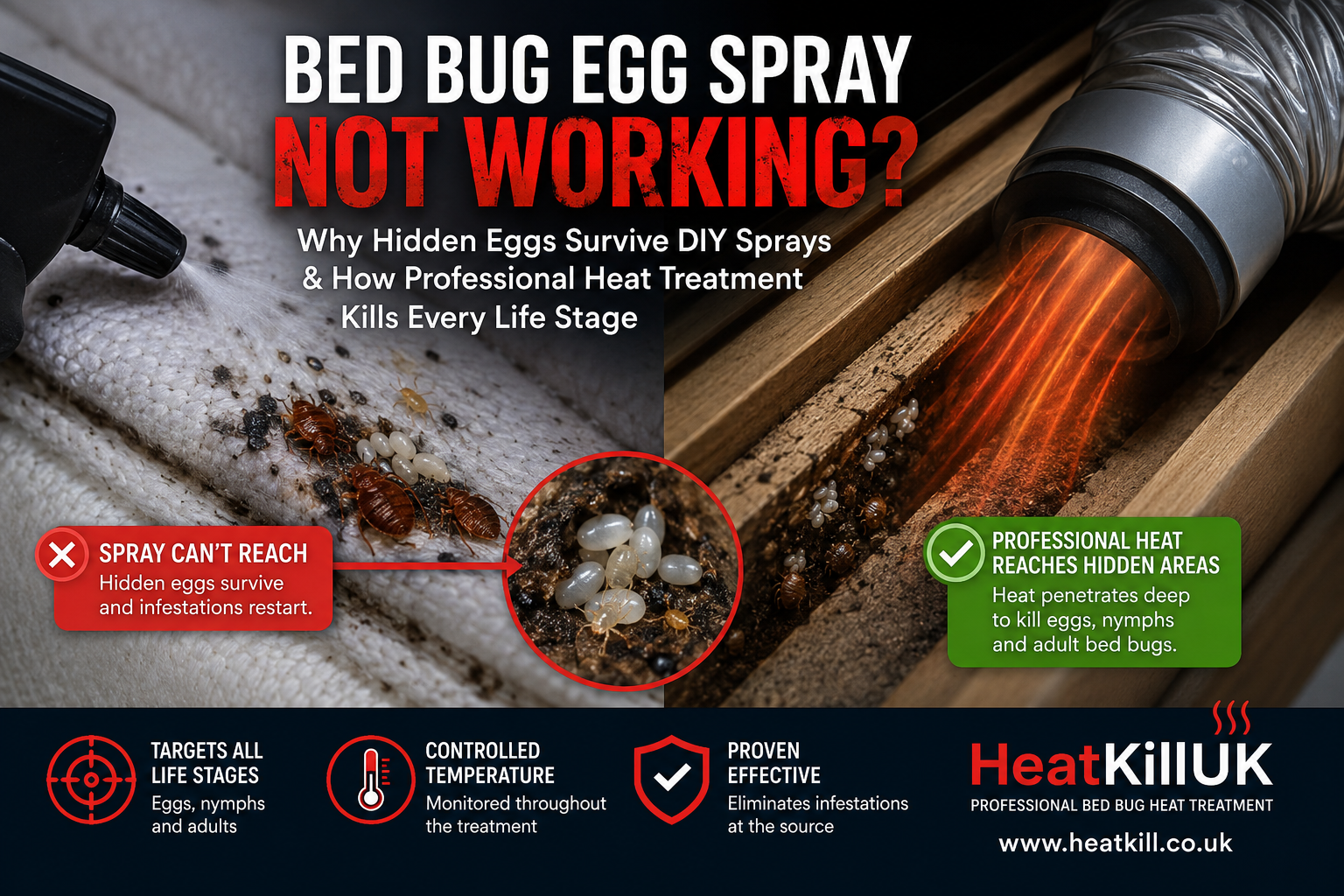
Even when a product kills exposed adult bed bugs, it may not destroy every egg. Eggs can remain hidden inside screw holes, furniture joints, fabric folds, cracks, flooring edges and other protected areas that the spray never reaches.
Once those eggs hatch, the infestation appears to return. In reality, part of the original infestation may have survived the treatment.
At HeatKillUK, we regularly speak to customers who have already spent considerable time and money on shop-bought sprays. Some have treated their rooms repeatedly, yet continue to experience bites.
This guide explains why bed bug egg spray can fail, where eggs are commonly hidden and why professional whole-room heat treatment can provide a more thorough solution.
Contents
- What are bed bug eggs?
- What do bed bug eggs look like?
- Where are bed bug eggs hidden?
- Why does bed bug egg spray not work?
- Spray must contact the egg
- The eggshell provides protection
- Not every spray kills eggs
- Bed bug insecticide resistance
- Why treatment can appear successful
- Can repeated spraying solve the problem?
What Are Bed Bug Eggs?
Bed bug eggs are the first stage of the bed bug life cycle. They are produced by adult female bed bugs and are normally deposited in sheltered areas close to where the insects hide.
The eggs are tiny, pale and easy to overlook. They do not move, bite or crawl into the open. This makes them much harder to detect than adult bed bugs.
A female bed bug does not normally place all her eggs in one obvious pile. Eggs can be spread across several harbourages within a room. Therefore, finding one group of eggs does not prove that every group has been located.
Bed bugs often live close to their sleeping host. However, established infestations can spread beyond the mattress and bed frame. Eggs may then be present throughout bedroom furniture, skirting areas, sofas and neighbouring rooms.
The NHS guidance on bed bugs explains that bed bugs commonly live in furniture and bedding. However, their flat bodies also allow them to enter extremely narrow cracks and gaps.
This ability to hide is one of the main reasons DIY spraying produces inconsistent results.
What Do Bed Bug Eggs Look Like?
Bed bug eggs are approximately the size of a small grain of salt. They are usually pearly white or cream-coloured and can be difficult to see without good lighting and close inspection.
Newly laid eggs can have a slightly translucent appearance. As the developing bed bug matures inside, the egg may become less transparent.
The eggs are often attached to a surface rather than lying loose. Female bed bugs produce a sticky substance that helps secure each egg to wood, fabric, paper or another suitable material.
This means normal vacuuming may remove some eggs but not necessarily all of them. Eggs fixed inside a narrow crack may remain in place even when the exposed surfaces have been cleaned.
They may also be confused with:
- Dust particles
- Flakes of dry skin
- Small pieces of fabric fibre
- Decorating debris
- Dried insecticide residue
- Other insect eggs
Finding suspected eggs is useful, but identification should not be based on eggs alone. Other evidence may include live bed bugs, cast skins, dark faecal spotting and blood marks on bedding.
Where Do Bed Bugs Hide Their Eggs?
Bed bugs usually lay their eggs in protected harbourages. These are dark, undisturbed spaces where adult bed bugs can remain concealed between blood meals.
Common locations include:
- Mattress seams and labels
- Behind headboards
- Inside bed-frame joints
- Under bed slats
- Inside screw and bolt holes
- Behind loose wallpaper
- Under carpet edges
- Behind skirting boards
- Inside bedside cabinets
- Under drawer runners
- Inside upholstered furniture
- Within divan bases
- Behind pictures and mirrors
- Around electrical fittings
- Inside cracks in walls and flooring
A quick spray over the mattress cannot reach all these locations.
People often concentrate on the visible sleeping surface because that is where bites are noticed. However, bed bugs may spend most of their time hidden elsewhere.
Divan beds and upholstered frames are particularly challenging. Eggs can be deposited behind thin fabric coverings or inside the wooden structure. Unless the bed is inspected carefully, these harbourages can remain completely hidden.
Ottoman beds can create similar problems because they contain hinges, storage cavities, fabric folds and overlapping panels. Each feature creates additional hiding places.
Bed bugs can also spread into sofas and armchairs when someone regularly rests or sleeps in the living room. Treating only the bedroom may then leave a second harbourage untouched.
This is why effective bed bug control should be based on the infestation as a whole, rather than treating only the place where bites were first noticed.
Why Does Bed Bug Egg Spray Not Work?
There is no single reason why bed bug egg spray fails. In most cases, several problems occur at the same time.
The spray may not reach the eggs. The active ingredient may have limited effect on the egg stage. The product may be applied incorrectly, or the infestation may be larger than expected.
In addition, the treatment may kill some exposed bed bugs while leaving concealed insects and eggs alive.
This partial reduction can create a misleading period of improvement. Bites decrease, fewer insects are seen, and the treatment appears to have worked.
However, surviving eggs can hatch. Hidden adults may also begin feeding again once the disturbance has passed.
The result is an infestation that seems to disappear and then return.
1. The Spray Must Reach the Bed Bug Egg
Most insecticide sprays depend on direct contact, residual contact or a combination of both.
Direct contact means that the liquid must land on the pest or egg during application. Residual action means that an insect must later cross a treated surface and absorb the active ingredient.
Neither method guarantees that a concealed bed bug egg will be killed.
An egg does not crawl across a treated surface. Therefore, it cannot pick up residual insecticide in the same way as an active nymph or adult.
For an insecticide to affect the egg itself, the product may need to make effective contact with it. This is unlikely when the egg is hidden:
- Deep inside a furniture joint
- Behind upholstery
- Under a fixed carpet edge
- Inside a wall crack
- Behind a skirting board
- Within a divan base
- Under an inaccessible floorboard
Applying more spray to the visible surface does not force it into every concealed space.
In fact, excessive liquid application can damage furniture, stain fabrics and increase unnecessary exposure to pesticides without solving the infestation.
Always follow the product label. The label determines where and how an authorised biocidal product may be used. The UK Health and Safety Executive maintains information about authorised biocidal products in the UK.
2. The Bed Bug Eggshell Provides Protection
Bed bug eggs are protected by an outer covering known as the chorion. This structure helps protect the developing bed bug from its surrounding environment.
Some insecticides that are effective against moving bed bugs have much less effect on the egg stage.
Scientific testing has demonstrated that the performance of insecticides against bed bug eggs can vary considerably. Some products allow a high proportion of eggs to hatch, even when they perform more effectively against nymphs or adult insects.
Research into insecticide resistance in bed bug eggs and first-stage nymphs also highlights the importance of evaluating eggs separately from moving life stages.
This distinction matters because a product labelled for use against bed bugs is not automatically guaranteed to kill every egg.
After an egg hatches, the emerging first-stage nymph may cross a treated surface and die. However, this depends on several factors:
- The residual insecticide must still be active.
- The nymph must cross a sufficiently treated area.
- The product must be effective against that bed bug population.
- The treatment must not have been removed by cleaning.
- The surface must be suitable for residual performance.
If any of these conditions are absent, the newly hatched nymph may survive.
3. Not Every Bed Bug Spray Is Ovicidal
An ovicidal product is one that can kill eggs. However, not every insecticide marketed for crawling insects has a strong ovicidal effect against bed bugs.
Some products primarily target the nervous system of mobile insects. An unhatched egg is biologically different from a feeding nymph or adult bed bug.
Therefore, it is important to distinguish between:
- A spray that kills exposed adult bed bugs
- A residual treatment that kills insects crossing a surface
- A product that has demonstrated activity against eggs
- A complete control programme designed to eliminate an infestation
These are not the same thing.
A spray may kill a bed bug when applied directly but still fail as a complete treatment. Similarly, a product with some ovicidal effect may not kill eggs hidden beyond the reach of the application.
Laboratory performance should not be confused with results inside an occupied home. In a laboratory, eggs can be deliberately exposed to a measured quantity of insecticide. In a bedroom, eggs may be concealed beneath fabric, behind furniture or inside structural gaps.
Even research in which a direct spray achieved substantial egg mortality did not always achieve complete mortality. This helps explain why a single application should not be viewed as a guaranteed cure.
4. Bed Bugs Can Be Resistant to Insecticides
Insecticide resistance is another reason bed bug sprays may underperform.
Resistance occurs when a bed bug population becomes less susceptible to an active ingredient that would previously have killed it.
Pyrethroids have historically been used in many household crawling-insect products. However, resistance to pyrethroid insecticides has been widely documented in bed bug populations.
Resistance does not mean every spray is useless. It does mean that repeatedly applying the same type of product may produce disappointing results, particularly when the insects are already difficult to reach.
Research reviewing insecticide effectiveness and resistance in bed bugs has reported resistance in field-collected populations.
Possible signs of a poorly performing spray treatment include:
- Live bed bugs remaining after direct application
- Continued sightings despite repeated treatment
- Fresh faecal spotting appearing
- Young nymphs appearing after several days
- Bites continuing after a short improvement
- Bed bugs spreading into neighbouring areas
However, resistance should not be blamed automatically. Treatment can also fail because of poor coverage, hidden harbourages, incorrect preparation or reinfestation.
5. The Spray Can Create a False Sense of Success
One of the most frustrating features of a bed bug infestation is the period of apparent calm after spraying.
You may stop seeing adult insects. Bites may reduce for a few nights. This can create the impression that the problem has been solved.
However, bed bugs do not necessarily feed every night. Reactions to bites can also vary or appear later. Therefore, bite activity is not a reliable way to confirm that every bed bug has died.
Meanwhile, hidden eggs may be continuing to develop.
Under suitable indoor conditions, many bed bug eggs can hatch in roughly one to two weeks. The exact timing depends on environmental conditions, including temperature.
When the young nymphs emerge, they require a blood meal to continue developing. This is often when fresh bites begin again.
Customers frequently describe this pattern:
- The room is sprayed.
- Activity seems to reduce.
- Several quiet days follow.
- Small bed bugs begin appearing.
- Bites restart.
- The room is sprayed again.
This cycle can continue for weeks or months when the underlying harbourages are not eliminated.
It can also lead people to use several products at once. Mixing or layering pesticides without professional knowledge may be unsafe and can interfere with a structured treatment plan.
Can Repeated Spraying Kill Bed Bug Eggs?
A correctly planned professional insecticide programme may require more than one visit. Follow-up treatments can target newly hatched nymphs that survived inside eggs during the first application.
However, repeatedly spraying the same visible areas with a shop-bought aerosol is not the same as a professional treatment programme.
Successful insecticidal control may require:
- A detailed inspection
- Correct identification
- Access to all affected rooms
- Suitable preparation
- Appropriate professional products
- Careful application to harbourages
- Dust treatment where appropriate
- Monitoring between visits
- A correctly timed follow-up treatment
Even then, insecticide treatment can be labour-intensive. It depends heavily on finding and reaching the areas where bed bugs are hiding.
Repeated DIY spraying can also make inspection harder. Wet residues, strong smells and excessive powder may contaminate surfaces or encourage bed bugs to move deeper into furniture and structural gaps.
More pesticide does not automatically mean better control.
The objective should be to expose every life stage to an effective treatment. That includes eggs, young nymphs, older nymphs and adult bed bugs.
Professional heat treatment approaches the problem differently. Instead of relying on a spray droplet to touch every egg, the aim is to raise temperatures throughout the treated area and inside suitable belongings to levels that are lethal to bed bugs.
However, heat treatment must be carried out correctly. Air temperature alone is not enough. Cold spots, insulated items and dense furniture must be considered and monitored.
Why Bed Bug Foggers and Smoke Bombs Often Fail
Bed bug foggers, smoke bombs and total-release aerosols can appear to be an easy solution. You place the product in the room, activate it and leave the treatment to disperse.
Unfortunately, this method is rarely effective against a well-established bed bug infestation.
The main problem is penetration. Fog and aerosol particles tend to settle on exposed surfaces. They do not reliably penetrate deep into:
- Bed-frame joints
- Mattress seams
- Divan bases
- Wall cracks
- Furniture cavities
- Skirting gaps
- Upholstery
- Floorboard voids
These protected areas are exactly where bed bugs and their eggs are likely to be hiding.
A fogger may kill some exposed insects. However, it is unlikely to reach every egg, nymph or adult bed bug inside the room.
Bed bug eggs do not crawl through insecticide deposits. Therefore, unless the active ingredient makes effective contact with the egg, it may remain unaffected.
Foggers can also disturb bed bugs. In some cases, insects may move away from treated surfaces and spread into adjoining rooms, wall voids or neighbouring furniture.
This can make the infestation more difficult to inspect and treat.
Why More Foggers Is Not the Answer
Using several foggers at once does not overcome the penetration problem.
It may increase chemical residue, odour, fire risk and unnecessary pesticide exposure without improving control inside hidden harbourages.
Rooms should never be treated with more pesticide than the label permits. Always follow the manufacturer’s instructions and do not combine products unless this is specifically authorised.
Bed bug treatment is not simply about filling a room with insecticide. The treatment must reach the pests where they live.
Can Steam Kill Bed Bug Eggs?
Steam can kill bed bugs and their eggs when it is applied correctly, and the required temperature reaches the target.
However, steam is a contact treatment. This means the steam must pass directly over the bed bug, egg or harbourage.
Steam does not leave a lasting residual effect. Once the treated area cools, it provides no ongoing protection against insects emerging from untreated gaps.
Steam can be particularly useful for treating:
- Mattress seams
- Bed-frame joints
- Headboards
- Upholstered furniture
- Carpet edges
- Fabric folds
- Visible clusters of eggs
However, successful steam treatment requires patience. The applicator must move slowly enough to transfer sufficient heat into the surface.
Passing a domestic steamer quickly over a mattress is unlikely to produce reliable control.
Problems With DIY Steam Treatment
Domestic steamers vary considerably in performance. Some produce wet steam, inconsistent temperatures or insufficient pressure.
Excess moisture can also damage furniture, fabrics and laminated materials.
Steam may not penetrate deeply enough into:
- Thick mattresses
- Dense upholstery
- Closed furniture joints
- Wall cavities
- Floor voids
- Insulated belongings
The treatment can also blow lightweight bed bug eggs or live insects away from the target if the nozzle pressure is too high.
Professional steam treatment is normally used as part of a wider control programme. It may be combined with inspection, vacuuming, insecticidal dust, monitoring and follow-up visits.
Steam can be highly useful, but it should not be confused with whole-room heat treatment.
Why Professional Heat Treatment Is More Effective Against Bed Bug Eggs
Professional bed bug heat treatment does not depend on spraying every individual egg.
Instead, specialist equipment is used to raise and maintain temperatures throughout the treatment area.
The objective is to expose bed bugs at every life stage to lethal heat, including:
- Eggs
- First-stage nymphs
- Older nymphs
- Adult males
- Adult females
This makes heat treatment particularly valuable when eggs are hidden inside furniture, bedding or belongings.
Hot air can circulate around and through suitable items in a way that an insecticide spray cannot.
However, professional heat treatment involves much more than placing a heater in a room.
Heat Must Reach the Coldest Areas
The temperature shown on a heater does not prove that the room has been treated successfully.
Bed bugs may survive in cold spots if heat does not penetrate sufficiently.
Potential cold spots include:
- Inside mattresses
- Under piles of clothing
- Inside packed drawers
- Behind furniture
- Under beds
- Inside boxes
- Near external walls
- Within dense sofas
- Inside cupboards
Professional heat treatment should therefore include temperature monitoring in several locations.
At HeatKillUK, temperatures are monitored throughout the treatment so that the coldest areas can be identified and addressed.
Furniture and belongings may need to be moved, opened or rearranged during treatment. Fans are used to improve air circulation and reduce the risk of untreated pockets.
Why Treatment Preparation Matters
Even powerful heat equipment cannot work effectively through badly packed belongings.
Closely packed wardrobes, sealed boxes, piles of clothing and clutter can insulate bed bugs from the surrounding heat.
Customers are normally provided with preparation instructions before treatment.
Preparation may include:
- Opening drawers and cupboards
- Loosening tightly packed clothing
- Removing heat-sensitive items
- Reducing excessive clutter
- Providing access around beds and furniture
- Keeping suitable belongings inside the treatment area
Items should not be removed from an infested room without guidance. Moving bedding, clothing or furniture through the property can spread bed bugs into previously unaffected areas.
Preparation should be controlled and methodical.
Does Heat Kill Bed Bug Eggs?
Yes. Bed bug eggs can be killed by heat when they are exposed to a sufficient temperature for a sufficient period.
Eggs are generally considered one of the more heat-tolerant stages of the bed bug life cycle. Therefore, a proper treatment must account for them.
This is why professional heat treatment should not rely on a brief spike in room temperature.
The lethal temperature must penetrate the areas where eggs are hidden and be maintained long enough to provide effective exposure.
Air temperature can rise quickly. Furniture, mattresses and dense belongings usually heat more slowly.
For example, the air near the heater may already be hot while the centre of a mattress remains considerably cooler.
Temperature sensors help confirm whether heat is reaching these slower-heating areas.
A professional treatment may also include moving furniture, turning mattresses and directing airflow into sheltered spaces.
Why Treating One Small Area May Not Be Enough
Bed bugs are often first discovered in one bedroom. However, this does not necessarily mean that the infestation is limited to that room.
Bed bugs may spread through:
- Shared walls
- Hallways
- Clothing
- Laundry
- Soft furniture
- Luggage
- Vacuum cleaners
- Moved bedding
People may also unintentionally spread the infestation by sleeping in another room after discovering bed bugs.
The insects follow the available host. Therefore, moving to a sofa or spare bedroom can encourage bed bugs to establish new harbourages.
Before recommending treatment, the extent of the infestation should be considered carefully.
In some properties, treating the affected bedroom may be appropriate. In others, several rooms or the complete property may require treatment.
Flats, houses in multiple occupation, hotels and divided buildings can present additional challenges because adjoining rooms or properties may also be affected.
What Should You Do If Bed Bug Egg Spray Has Failed?
If you are still seeing bed bugs after using a spray, avoid immediately applying another product.
First, assess what is happening.
1. Look for Physical Evidence
Check for reliable signs of bed bugs, including:
- Live insects
- Cast skins
- Dark faecal spotting
- Blood marks
- Eggs
- Young pale-coloured nymphs
Bites alone are not enough to confirm active bed bugs because skin reactions can have several causes.
2. Do Not Move Into Another Room
Continue sleeping in the normal sleeping area unless a professional advises otherwise.
Moving to another bedroom or sofa can cause surviving bed bugs to spread in search of a blood meal.
3. Stop Moving Belongings Around the Property
Avoid carrying bedding, clothes, cushions or furniture into unaffected rooms.
Items that require washing should be contained in sealed bags before they are moved.
After laundering or heat drying, clean items should be placed into fresh sealed bags or containers.
4. Do Not Dispose of Furniture Immediately
Beds, mattresses and sofas can often be treated successfully.
Throwing furniture away can spread bed bugs through communal areas, vehicles or the property entrance.
Replacement furniture may also become infested if the room has not been treated first.
5. Keep a Record of Products Used
Make a note of every spray, powder, fogger or chemical used.
A professional technician needs this information before starting another treatment.
Certain residues may affect inspection, preparation or the choice of treatment.
6. Arrange a Professional Assessment
A professional inspection can help determine whether bed bugs are still active, how far they have spread and which treatment method is most suitable.
Explain how long the infestation has been present, which rooms are affected and what DIY treatments have already been attempted.
Common Reasons DIY Bed Bug Treatment Fails
DIY bed bug treatment often fails because the infestation is underestimated.
Common mistakes include:
- Spraying only the mattress
- Missing the bed frame and headboard
- Ignoring sofas and chairs
- Using only one treatment
- Cleaning treated surfaces too soon
- Using the wrong product
- Applying too little product
- Applying excessive product
- Failing to treat neighbouring rooms
- Moving infested belongings
- Sleeping in another room
- Relying only on bite reactions
Bed bugs are not impossible to control, but they are exceptionally good at avoiding incomplete treatment.
A small untreated harbourage can contain enough eggs or insects to restart the infestation.
Professional Bed Bug Treatment From HeatKillUK
HeatKillUK provides professional bed bug heat treatment for homes, flats, landlords, hotels and other properties across many parts of England.
Our treatment approach is designed to target the complete infestation rather than only the bed bugs visible on the mattress.
Depending on the property and the level of activity, treatment may include:
- Professional indirect heat equipment
- Multiple temperature sensors
- Air-movement fans
- Furniture repositioning
- Mattress and bed-frame treatment
- Monitoring of cold spots
- A detailed preparation process
- Follow-up inspection or treatment where included
We use specialist heaters positioned outside the property, with heated air ducted safely into the treatment area.
This avoids using small domestic electric heaters that may struggle to heat a complete room evenly.
During treatment, temperatures are monitored and adjusted. Furniture and belongings are managed carefully to help heat reach concealed harbourages.
For more information about professional treatment, visit HeatKillUK bed bug heat treatment services.
How to Reduce the Risk of Bed Bugs Returning
No treatment can prevent a new bed bug from being brought into a property in the future.
Bed bugs can be transported in luggage, clothing, furniture and personal belongings.
However, several practical steps can reduce the risk of a new infestation becoming established.
- Inspect second-hand furniture before bringing it indoors.
- Check hotel beds and headboards when travelling.
- Keep luggage away from hotel beds and soft furniture.
- Wash and heat-dry travel clothing after returning home.
- Use sealed luggage bags where practical.
- Inspect beds regularly if you travel frequently.
- Act quickly when reliable signs appear.
Mattress encasements can help simplify future inspection, but they do not prevent bed bugs from living elsewhere in the room.
Bed-leg interceptors may also help monitor activity. However, monitoring devices should not be treated as a complete solution.
Frequently Asked Questions About Bed Bug Egg Spray
Does bed bug spray kill eggs?
Some products may kill exposed bed bug eggs, but performance varies. Many sprays are more effective against moving bed bugs than eggs. Hidden eggs may survive because the spray does not reach them.
Why am I seeing baby bed bugs after spraying?
Young bed bugs may appear when eggs survive the original treatment and later hatch. They may also have been hidden as small nymphs when the room was sprayed.
How long after spraying can bed bug eggs hatch?
Under suitable indoor conditions, bed bug eggs may hatch in approximately one to two weeks. Temperature and environmental conditions can affect the timing.
Should I spray again when eggs hatch?
Do not apply another treatment automatically. Check the product label and consider professional advice. Repeated uncontrolled spraying can create unnecessary exposure and may not reach the hidden infestation.
Can I spray bed bug eggs directly?
A product specifically authorised for the intended use may affect exposed eggs when applied according to the label. However, visible eggs may represent only a small part of the infestation.
Does bleach kill bed bug eggs?
Bleach is not a suitable bed bug treatment. It can damage furniture and fabrics, irritate the skin and lungs and create dangerous fumes if mixed with other cleaning chemicals.
Does alcohol kill bed bug eggs?
Alcohol is unreliable and highly flammable. It should not be sprayed around beds, furniture, electrical fittings or heated areas as a DIY bed bug treatment.
Do bed bug bombs kill eggs?
Bed bug bombs and foggers are unlikely to reach eggs hidden inside furniture, walls and other protected areas. They may kill some exposed insects but frequently fail to eliminate the infestation.
Can a hairdryer kill bed bug eggs?
A hairdryer is not an effective room treatment. It cannot distribute or monitor heat evenly, and it may cause bed bugs to move deeper into hiding places.
Does washing bedding kill bed bug eggs?
Hot washing and tumble drying can help kill bed bugs and eggs on washable items. However, laundering bedding alone will not treat the bed frame, furniture or room.
Can bed bug eggs survive vacuuming?
Some eggs may remain attached to surfaces or hidden inside cracks. Vacuuming can reduce visible activity but should be used as part of a wider treatment plan.
Will one heat treatment kill bed bug eggs?
A correctly prepared, professionally monitored heat treatment is designed to kill all bed bug life stages during the treatment. Success depends on achieving lethal temperatures throughout the affected area, including cold spots and dense items.
Do I need to throw away my mattress?
Usually not. Mattresses can often be treated successfully. Replacing a mattress before the room is treated can result in the new mattress becoming infested.
Can bed bugs come back after heat treatment?
Bed bugs can return if they are reintroduced from another property, untreated room, adjoining flat, luggage or infested belongings. A professional assessment helps reduce the risk of untreated areas being missed.
Bed Bug Egg Spray Not Working? Treat the Complete Infestation
When bed bug egg spray is not working, the problem is rarely solved by simply applying more spray.
Bed bug eggs are small, protected and hidden in places that ordinary aerosols cannot reach. Even when exposed adults are killed, surviving eggs can hatch and restart the infestation.
Foggers, repeated aerosols and surface spraying may create a temporary reduction in activity. However, they do not necessarily eliminate bed bugs living inside furniture, upholstery or structural gaps.
Professional heat treatment targets the infestation differently. It is designed to expose eggs, nymphs and adults to lethal temperatures throughout the treatment area.
The process must be carefully prepared, monitored and managed to ensure that heat reaches cold spots and concealed harbourages.
If you are still experiencing bed bug activity after using DIY sprays, contact HeatKillUK to discuss professional bed bug heat treatment.
Provide details about the property, the rooms affected, and any products already used. This will help us recommend the most suitable next step.
Get Help With a Persistent Bed Bug Infestation
Have bed bug sprays failed to solve the problem?
HeatKillUK provides specialist bed bug heat treatment using professional heating equipment, air circulation and multi-point temperature monitoring.
Visit www.heatkill.co.uk to request advice or a treatment quotation.