How Good Is DIY Insecticide for Bed Bugs

How Good Is DIY Insecticide for Bed Bugs?
Reviewed by Richard Collings – HeatKillUK
Last Reviewed: July 2026
Reading Time: Approximately 18 minutes
Last Reviewed: July 2026
Reading Time: Approximately 18 minutes
Table of Contents
- What Is a DIY Bed Bug Insecticide?
- Why Bed Bugs Are So Difficult to Kill
- The Different Types of DIY Bed Bug Insecticides
- How Well Do DIY Insecticides Actually Work?
- Can DIY Insecticides Kill Bed Bug Eggs?
- Why Bed Bug Resistance Is Growing
- The Biggest Mistakes People Make
- When DIY Treatments Can Be Effective
- DIY vs Professional Insecticides
- DIY vs Heat Treatment
- Frequently Asked Questions
- Final Verdict
Introduction
Discovering bed bugs in your home can be one of the most stressful pest problems you will ever face.
For many people, the first reaction is to search online for a bed bug spray or insecticide that promises to solve the problem quickly and cheaply. Walk into almost any DIY store or browse online marketplaces and you'll find dozens of products claiming to kill bed bugs on contact or eliminate an infestation entirely.
Some are inexpensive aerosol sprays. Others are concentrated insecticides that need mixing with water. You can also buy insecticidal powders, smoke bombs, foggers and mattress treatments, all marketed as simple solutions.
So, how good are DIY insecticides for bed bugs?
The honest answer is that they can be very effective in certain situations—but they also have significant limitations.
A good-quality insecticide, used correctly, can kill bed bugs that come into direct contact with it. However, eliminating an established infestation is far more complex than spraying a mattress or treating a bedroom once.
At HeatKillUK, we've attended many properties where customers have already tried one or several DIY products before contacting us. Some have spent hundreds of pounds on sprays, powders and foggers. Others have followed every instruction on the label carefully, only to find that the bites persist for weeks.
That doesn't necessarily mean the products are poor. More often, it reflects the remarkable biology and behaviour of bed bugs themselves.
These insects are masters of concealment. They hide in tiny cracks, reproduce quickly, and can survive for months without feeding. Many populations have also developed resistance to commonly used insecticides, making complete eradication increasingly difficult without a well-planned treatment strategy.
This guide takes a balanced look at DIY insecticides. We'll explain where they perform well, where they fall short, and how they compare with professional chemical treatments, steam treatment and whole-room heat treatment.
By the end, you'll have a realistic understanding of what DIY products can achieve—and when it's time to consider professional help.
What Is a DIY Bed Bug Insecticide?
A DIY bed bug insecticide is any pesticide available to members of the public that is designed to kill bed bugs without the need for a professional pest controller.
These products come in several forms, including:
- Ready-to-use aerosol sprays
- Pump-action trigger sprays
- Concentrated insecticides that are diluted before use
- Residual insecticide sprays
- Insecticidal dusts and powders
- Smoke generators
- Total release foggers
Each works slightly differently, but they all have one goal: to expose bed bugs to an active ingredient that affects their nervous system or disrupts their normal development.
Some products provide only an immediate knockdown of exposed insects, while others leave a residual deposit that continues working for days or weeks after application.
It's important to understand that not all insecticides are the same. Their effectiveness depends on several factors, including:
- The active ingredients used
- How thoroughly the product is applied
- Whether the bed bugs have developed resistance
- The size of the infestation
- The number of hidden harbourages
- Whether eggs are present
This is why two homeowners using different products—or even the same product—can experience very different results.
Why Bed Bugs Are So Difficult to Kill
To understand why DIY insecticides sometimes fail, it's important to understand the insect you're trying to eliminate.
Unlike ants or wasps, bed bugs do not live in large exposed nests. Instead, they spend almost all of their lives hidden in narrow cracks and crevices near where people sleep.
Common hiding places include:
- Mattress seams
- Divan bases
- Bed frames
- Behind headboards
- Furniture joints
- Skirting boards
- Behind loose wallpaper
- Electrical sockets
- Carpet edges
- Curtain headings
- Behind pictures and mirrors
- Inside bedside cabinets
- Cracks in flooring
- Wall voids
Many of these locations are almost impossible to treat thoroughly using DIY products.
A typical homeowner may only ever see a handful of live bed bugs, even when hundreds are present.
Professional inspections regularly uncover harbourages containing dozens—or even hundreds—of insects hidden inside furniture or structural gaps that would never be noticed during routine cleaning.
Bed bugs also feed quickly, usually at night, before disappearing back into their hiding places.
This means that simply spraying visible insects rarely addresses the majority of the infestation.
The Different Types of DIY Bed Bug Insecticides
Not all DIY insecticides work in the same way.
Understanding the differences can help you choose the most appropriate product—and avoid unrealistic expectations.
Aerosol Sprays
Aerosols are among the most popular DIY options because they're easy to use and require no preparation.
Many contain fast-acting insecticides that kill exposed bed bugs on contact.
Their main limitation is penetration.
A fine mist cannot easily reach deep cracks, furniture joints or wall voids where most bed bugs spend their time.
As a result, aerosols are often most useful for treating exposed insects rather than complete infestations.
Residual Liquid Sprays
Residual insecticides are designed to leave a thin deposit on treated surfaces.
Instead of killing immediately, they continue working after application by affecting bed bugs that crawl across the treated area.
When used correctly, they can remain active for days or even weeks, depending on the product, the surface treated and normal household wear.
Residual sprays are often more effective than simple knockdown aerosols because they continue working after application, but they still rely on bed bugs crossing the treated surface.
If insects remain hidden in untreated areas, they may avoid exposure altogether.
Insecticidal Dusts
Dust formulations can be particularly useful in dry, inaccessible locations where liquid sprays are unsuitable.
Professionals often use insecticidal dusts in places such as electrical socket back boxes, wall voids and inaccessible structural gaps, following the product label and appropriate safety precautions.
For homeowners, however, correct application can be challenging. Too much dust can actually reduce effectiveness, while applying it in the wrong places can create unnecessary exposure risks.
Like residual sprays, dusts work best as part of a wider treatment strategy rather than as a stand-alone solution.
How Well Do DIY Insecticides Actually Work?
This is perhaps the most important question homeowners ask.
The simple answer is:
DIY insecticides can work—but success depends on the size of the infestation, where the bed bugs are hiding, the product used, and how thoroughly it is applied.
There is no single spray that guarantees the complete elimination of an established bed bug infestation.
In our experience at HeatKillUK, customers generally fall into one of three groups.
1. Very Early Infestations
Sometimes a person brings home a single pregnant female bed bug or a few insects after travelling.
The infestation is discovered quickly, before it spreads throughout the room.
In these circumstances, careful inspection, appropriate insecticide application, and ongoing monitoring may successfully address the problem.
Early detection is the biggest advantage.
2. Moderate Infestations
This is where most homeowners find themselves.
Bed bugs have been present for several weeks or months.
People may be waking with bites every few days and occasionally spotting live insects.
The infestation has often spread beyond the bed to nearby furniture.
DIY insecticides may reduce numbers significantly, but complete eradication becomes much more difficult because hidden harbourages and eggs remain.
3. Established Infestations
Large infestations are a different challenge altogether.
By this stage, bed bugs may have spread into:
- Multiple bedrooms
- Sofas
- Living rooms
- Hallways
- Electrical sockets
- Wall voids
- Skirting boards
- Cupboards
- Stored belongings
At this point, relying on a single DIY spray is unlikely to resolve the problem.
This doesn't mean the insecticide has failed—it simply means the infestation has outgrown what one product can realistically achieve.
Can DIY Insecticides Kill Bed Bug Eggs?
One of the biggest misconceptions is that spraying visible bed bugs solves the entire problem.
Unfortunately, bed bug eggs make eradication much more difficult.
Female bed bugs lay tiny white eggs, often cementing them deep inside cracks, furniture joints and other protected locations.
These eggs are remarkably resilient.
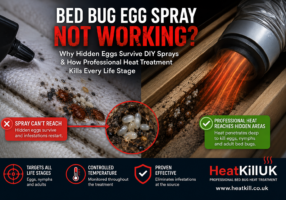
Many insecticides have limited ovicidal (egg-killing) activity, meaning they are much less effective against eggs than against active bed bugs. As a result, even after a successful treatment of adults and nymphs, surviving eggs may hatch days later.
Once the young nymphs emerge, they begin searching for a blood meal.
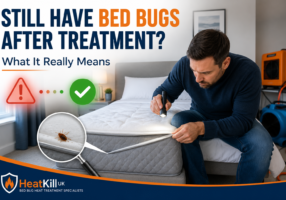
This is why many DIY treatments appear successful at first.
For several days, there are no bites.
Then, one or two weeks later, the bites return.
The insects are often newly hatched nymphs rather than survivors from the original treatment.
For this reason, many treatment programmes—both DIY and professional—require repeat inspections and, where appropriate, follow-up treatments timed to target newly emerged insects.
The Challenge of Insecticide Resistance
Another factor that has changed bed bug control dramatically over the past two decades is insecticide resistance.
Bed bugs are incredibly adaptable.
Where the same types of insecticides are used repeatedly over many years, resistant individuals are more likely to survive and reproduce. Over time, this can reduce the effectiveness of certain active ingredients against some bed bug populations.
This does not mean every bed bug in the UK is resistant to every insecticide.
Resistance varies depending on the population and the active ingredient involved.
However, it does explain why products that once worked exceptionally well may no longer provide the same level of control on their own.
Professional pest controllers increasingly use integrated pest management (IPM) rather than relying on a single chemical. This may combine careful inspection, targeted insecticide use, steam, monitoring devices and, where appropriate, whole-room heat treatment.
Why Foggers and Smoke Bombs Often Disappoint
One of the most common DIY purchases is a total-release fogger or smoke generator.
They seem attractive because they fill a room with insecticide without much effort.
Unfortunately, bed bugs rarely remain exposed long enough for these products to eliminate an infestation.
The fine particles tend to settle on exposed surfaces rather than penetrating deep into:
- Divan bases
- Mattress interiors
- Wall voids
- Furniture joints
- Electrical fittings
- Behind skirting boards
A fogger may kill some exposed insects, but hidden bed bugs often survive.
In addition, if used incorrectly, foggers may cause bed bugs to disperse into neighbouring rooms rather than resolving the infestation.
This is one reason many professionals use fogging only in very specific situations and not as the primary treatment for bed bugs.
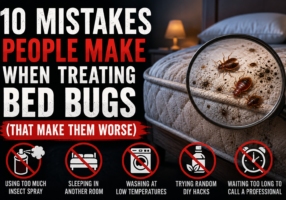
The Biggest Mistakes Homeowners Make
After visiting many properties, we've noticed the same mistakes recur.
Avoiding these can significantly improve your chances of success.
Spraying Only the Mattress
Many people assume the mattress is where bed bugs live.
In reality, the mattress is often just one of many harbourages.
Treating only the mattress leaves numerous hiding places untouched.
Using Too Much Insecticide
It is easy to think:
"If a little works, more must work better."
Unfortunately, excessive application can:
- Reduce the effectiveness of some products.
- Increase unnecessary chemical exposure.
- Leave visible residues or staining.
- Make future inspections more difficult.
Always follow the product label exactly.
Stopping Too Soon
After treatment, homeowners often stop looking for bed bugs as soon as the bites disappear.
Unfortunately, surviving eggs may still hatch later.
Continued monitoring for several weeks is essential.
Ignoring Other Rooms
Bed bugs don't always stay in one bedroom.
If the infestation has spread into sofas, spare bedrooms or adjoining rooms, treating only one area may allow surviving insects to continue breeding.
Not Inspecting Furniture Properly
Some of the largest infestations we've encountered have been hidden inside:
- Bed frames
- Divan bases
- Bedside cabinets
- Recliner chairs
- Sofas
- Wardrobes
Without dismantling furniture where appropriate, these harbourages can easily be overlooked.
When DIY Insecticides Can Be Effective
Despite their limitations, DIY insecticides certainly have a role.
They may be appropriate when:
- You have found only one or two bed bugs and acted quickly.
- The infestation has been confirmed as very small.
- You are carrying out ongoing monitoring after travel.
- They are used as part of a wider integrated approach rather than as the only treatment.
The key is having realistic expectations.
DIY products can reduce bed bug numbers and, in some cases, eliminate very early infestations.
However, as infestations become larger and more widespread, the chances of success generally decrease.
Why Professionals Rarely Rely on One Method
One of the biggest differences between DIY and professional pest control is that experienced pest controllers rarely rely on a single technique.
Instead, they choose the most appropriate combination for the situation.
This may include:
- Detailed inspection.
- Careful dismantling of furniture where necessary.
- Targeted application of professional-use insecticides (where appropriate and in accordance with the product label).
- Steam treatment for immediate control in suitable locations.
- Monitoring devices.
- Follow-up inspections.
- Whole-room heat treatment for suitable infestations.
The aim is not simply to kill the insects that are visible today, but to break the entire life cycle and reduce the risk of the infestation returning.
DIY Insecticide vs Professional Insecticides
Many people assume that professional pest controllers simply use a "stronger version" of the sprays available in DIY stores.
The reality is more complicated.
Professional treatment isn't just about the product—it's about knowledge, inspection, application technique and choosing the right combination of control methods.
A skilled technician may spend considerable time inspecting a room before applying any insecticide. They understand where bed bugs are likely to hide, how they move around a property and which harbourages need the most attention.
Professional treatments may involve:
- A detailed inspection of all affected rooms.
- Dismantling bed frames where appropriate.
- Inspecting divan bases internally.
- Checking bedside furniture.
- Examining skirting boards and flooring.
- Inspecting upholstered furniture.
- Identifying the likely source and extent of the infestation.
- Applying products only where the product label permits and where they are most likely to be effective.
This targeted approach often makes a greater difference than simply using a different insecticide.
DIY Insecticide vs Steam Treatment
Steam has become increasingly popular in bed bug control because it offers an immediate, non-residual method of killing bed bugs and eggs when applied correctly.
Unlike insecticides, steam relies on high temperatures rather than chemicals.
When the correct surface temperature is achieved and the steam is applied slowly enough, it can kill:
- Adult bed bugs
- Nymphs
- Eggs
This is one of steam's biggest advantages.
However, steam also has limitations.
It only works where the steam actually reaches.
Deep wall voids, heavily insulated furniture or inaccessible structural cavities may still remain untreated.
Steam also requires patience and experience. Moving the nozzle too quickly can prevent sufficient heat from penetrating the treated surface.
For this reason, professional steam treatments are usually carried out methodically, paying particular attention to seams, joints, cracks and other likely harbourages.
At HeatKillUK, steam is often used as part of an integrated treatment strategy rather than as a complete replacement for every other control method.
DIY Insecticide vs Whole-Room Heat Treatment
Whole-room heat treatment takes a very different approach.
Instead of relying on chemicals or treating individual harbourages, specialist heating equipment raises the temperature of the treatment area until lethal temperatures are achieved throughout the room.
When properly planned and monitored, the aim is to heat not just the air but also furniture, mattresses and many hidden harbourages where bed bugs may be hiding.
Professional heat treatment offers several potential advantages:
- No reliance on insecticide resistance.
- Heat can penetrate many difficult-to-access areas more effectively than surface sprays.
- Adults, nymphs and eggs are affected by lethal temperatures when those temperatures are reached and maintained.
- Immediate treatment without waiting for insects to contact a treated surface.
- Reduced reliance on repeated chemical applications.
However, successful heat treatment depends on careful preparation, commercial equipment and continuous temperature monitoring.
Simply making a room feel hot is not enough.
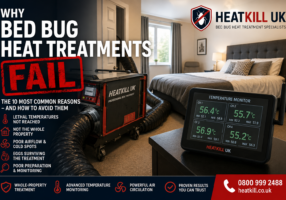
Objects such as mattresses, sofas, wardrobes and thick furnishings take time to absorb heat. Professional technicians therefore place temperature sensors throughout the property to confirm that lethal temperatures have been achieved and maintained where it matters—not just in the middle of the room.
At HeatKillUK, every whole-property heat treatment is continuously monitored using multiple wireless temperature sensors. This allows us to verify that target temperatures have been reached across the treatment area and maintained for the required period.
Cost Comparison
One reason many homeowners try DIY insecticides first is cost.
A can of bed bug spray is far cheaper than professional treatment.
However, the initial purchase price doesn't always reflect the total cost of eliminating an infestation.
Many customers purchase:
- Multiple aerosol sprays
- Residual insecticides
- Insecticidal dusts
- Smoke generators
- Mattress encasements
- Steam cleaners
- Monitoring traps
Over several weeks or months, these purchases can add up significantly.
There is also the hidden cost of:
- Replacing infested furniture unnecessarily.
- Taking time off work.
- Repeated laundering at high temperatures.
- Ongoing stress and loss of sleep.
- Continuing bites.
For some homeowners, DIY treatment is successful and represents excellent value.
For others, repeated unsuccessful attempts simply delay effective treatment while allowing the infestation to grow.
Choosing the right approach often depends on the size of the infestation, how early it was discovered and your confidence in carrying out a thorough inspection and treatment programme.
Frequently Asked Questions
What is the best DIY insecticide for bed bugs?
There is no single product that is universally "best". The most appropriate choice depends on the size of the infestation, where the bed bugs are hiding and whether resistance may be present. Always choose a product that is approved for bed bug control and follow the manufacturer's instructions.
Why do bed bugs keep coming back after spraying?
This is often due to one or more of the following:
- Eggs hatching after treatment.
- Hidden bed bugs avoiding the insecticide.
- Untreated rooms or furniture.
- Reintroduction from luggage or second-hand items.
- Reduced susceptibility to certain insecticides.
A repeat inspection is usually needed to identify the cause.
Can I sleep in my bed after using insecticide?
Always follow the product label carefully. Some products require treated surfaces to dry completely before they are used again, and many are not intended for direct application to mattresses or sleeping surfaces.
Should I throw my mattress away?
In many cases, no.
Mattresses can often be successfully treated as part of a professional treatment programme. Disposing of a mattress without addressing the rest of the infestation rarely solves the underlying problem.
Are natural sprays as effective as insecticides?
Some natural products may kill bed bugs on direct contact, but there is limited evidence that they can reliably eliminate established infestations on their own. They should not be viewed as a guaranteed substitute for a comprehensive treatment strategy.
Is heat treatment worth the cost?
For established infestations, professionally delivered whole-room heat treatment can provide a rapid, comprehensive solution because it is not dependent on insects contacting a treated surface. Whether it is the right option depends on the property, the extent of the infestation and the treatment provider's methods.
Final Verdict
So, how good is DIY insecticide for bed bugs?
The answer is neither "excellent" nor "useless."
DIY insecticides have an important role in bed bug control and can be highly effective in the right circumstances. They may successfully deal with very early infestations or reduce bed bug numbers while further action is planned.
However, established infestations present a much greater challenge.
Hidden harbourages, bed bug eggs and insecticide resistance can all reduce the likelihood of complete eradication using DIY products alone.
This is why professional bed bug control rarely relies on a single spray or a single visit.
Instead, success usually comes from a carefully planned treatment programme that may combine detailed inspection, targeted insecticide use where appropriate, steam treatment, monitoring and, for suitable infestations, whole-room heat treatment.
If you've already tried DIY insecticides and are still finding live bed bugs or waking with fresh bites, it may be time for a professional assessment.
At HeatKillUK, we specialise in whole-property bed bug heat treatment, using commercial heating equipment and continuous temperature monitoring to thoroughly tackle infestations. Our approach is designed to treat the property as a whole, helping to reach many of the places where bed bugs commonly hide and reducing reliance on repeated chemical applications.
If you'd like honest advice about the most appropriate treatment for your home, we're always happy to discuss your situation and recommend the option that best fits your cir