Why Bed Bug Heat Treatments Fail
Why Bed Bug Heat Treatments Fail: 10 Common Mistakes That Lead to Reinfestation
A Complete Guide from HeatKill UK
Finding bed bugs in your home is stressful enough. Paying for treatment only to discover the bites return a few weeks later can be even more frustrating.
One of the first questions people ask is:
"Why did my bed bug heat treatment fail?"
The good news is that professional bed bug heat treatment is one of the most effective methods available for eliminating bed bugs. When carried out correctly, it can destroy adult bed bugs, nymphs and eggs without relying solely on insecticides.
The problem is that not all heat treatments are carried out to the same standard.
We've attended properties where previous companies claimed to have completed a successful heat treatment, yet bed bugs were still present. In many cases, the treatment itself wasn't the issue—it was how it was planned, monitored or carried out.
Sometimes the infestation wasn't even a treatment failure. The bed bugs had simply been brought back into the property after the original infestation had been eliminated.
In this guide, we'll explain the ten most common reasons why bed bug heat treatments fail, how to avoid these costly mistakes, and what you should expect from a professional whole-property heat treatment.
Whether you're considering booking a treatment or you're worried that your existing treatment hasn't worked, this guide will help you understand the process and make an informed decision.
Contents
- What Is Bed Bug Heat Treatment?
- Why Heat Treatment Is So Effective
- 10 Reasons Bed Bug Heat Treatments Fail
- Why Whole-Property Heat Treatment Matters
- How Professional Temperature Monitoring Works
- Common Myths About Heat Treatment
- What to Do After Treatment
- Frequently Asked Questions
- Why Choose HeatKill UK
What Is Bed Bug Heat Treatment?
Professional bed bug heat treatment is a specialist pest control method that uses controlled high temperatures to eliminate bed bugs throughout a property.
Instead of relying solely on insecticides, commercial heating equipment raises the temperature in affected rooms to levels lethal to all life-cycle stages of bed bugs.
This includes:
- Adult bed bugs
- Juvenile bed bugs (nymphs)
- Bed bug eggs
Unlike many chemical treatments, heat has the advantage of penetrating many places where bed bugs naturally hide, including mattresses, bed frames, furniture, and cracks in walls.
However, successful treatment isn't simply about making a room feel hot.
Professional heat treatment requires:
- Commercial heating equipment
- Industrial air circulation
- Careful planning
- Continuous temperature monitoring
- Correct preparation
- Experienced technicians
Without these elements, there's a much greater risk that some bed bugs—or their eggs—will survive.
For general information about bed bugs, the NHS bedbugs guide explains how to recognise an infestation, while the British Pest Control Association (BPCA) provides advice on choosing a professional pest control company.
Why Heat Treatment Is One of the Best Bed Bug Treatments
Over the past two decades, bed bugs have become increasingly resistant to many commonly used insecticides.
This is one of the main reasons professional heat treatment has become so popular across the UK.
When correctly performed, heat treatment offers several important advantages:
- Kills all life stages, including eggs.
- Reduces reliance on insecticides.
- Can treat mattresses and furniture without disposal.
- Reaches many hidden harbourages.
- Provides rapid control compared with repeated chemical applications.
- Minimises disruption when compared with multiple treatment visits.
However, these benefits are only achieved when the treatment is properly planned and monitored.
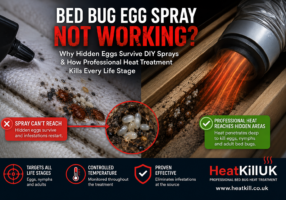
A property may feel extremely warm, yet hidden areas behind fitted furniture, inside wardrobes or beneath clutter may still remain below lethal temperatures.
Professional monitoring is therefore one of the most important parts of the entire process.
Expert Tip
At HeatKill UK, we don't judge a treatment by the temperature displayed on a heater.
We judge it by the temperatures recorded throughout the property using multiple sensors placed in difficult locations.
That's because bed bugs don't hide next to the heater—they hide where the heat is hardest to reach.
1. Treating Only One Room Instead of the Whole Property
One of the biggest reasons bed bug heat treatments fail is because only the room where bites have been noticed is treated.
At first glance, this seems logical. If you're being bitten in the bedroom, surely that's where the bed bugs are?
Unfortunately, bed bugs don't always stay close to the bed.
As an infestation grows, it spreads surprisingly easily throughout a property, hiding anywhere it can find warmth, darkness, and a narrow crack to squeeze into.
During inspections, we've discovered bed bugs in:
- Living room sofas
- Armchairs
- Hallways
- Spare bedrooms
- Wardrobes
- Bedside cabinets
- Behind skirting boards
- Electrical sockets
- Curtain folds
- Picture frames
- Luggage
- Laundry baskets
- Clothing
- Under carpets
- Boxes stored in cupboards
Many homeowners are surprised to learn that bed bugs can travel several metres in a single night in search of a blood meal.
Why This Causes Heat Treatments to Fail
If only one bedroom is heated, bed bugs hiding elsewhere may simply avoid the treatment.
Once the property cools down, they begin moving again and eventually return to the bedroom.
To the homeowner, it appears the treatment has failed.
In reality, the infestation was never completely treated.
This is one of the main reasons HeatKill UK often recommends whole-property heat treatment, especially where:
- The infestation has existed for several months.
- Multiple rooms show signs of activity.
- Occupants sleep in different rooms.
- Bed bugs have spread through adjoining furniture.
Professional inspections are essential because bed bugs rarely read the rule book.
Expert Tip
If you've already started sleeping in another bedroom because of the bites, there's a good chance the bed bugs have started following you.
Changing sleeping locations rarely solves the problem and often encourages the infestation to spread further.
2. The Property Never Reached Lethal Temperatures
This is probably the most misunderstood reason why bed bug heat treatments fail.
Many people believe that if a room feels unbearably hot, every bed bug inside must be dead.
Unfortunately, that's simply not true.
The temperature you feel standing in the middle of a room may be completely different from the temperature inside:
- Thick mattresses
- Divan bases
- Wardrobes
- Dense clothing
- Boxes
- Furniture joints
- Wall voids
Bed bugs don't sit in open spaces waiting to be heated.
They hide in the most insulated places they can find.
Air Temperature Isn't Enough
Professional heat treatment isn't about how hot the air becomes.
It's about ensuring that the actual hiding places reach lethal temperatures for long enough to eliminate:
- Adult bed bugs
- Juveniles (nymphs)
- Eggs
Without proper monitoring, there's simply no way of knowing whether this has happened.
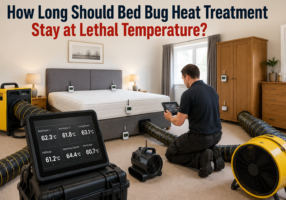
At HeatKill UK, we place temperature sensors throughout the property—not just beside the heaters.
These sensors allow us to monitor temperatures continuously and identify areas that require additional airflow or more heating time.
Why Professional Monitoring Matters
Commercial heat treatment should never rely on guesswork.
A professional technician should know:
- Which room is heating too slowly.
- Which wardrobe remains cool.
- Whether a mattress has fully heated through.
- Whether thick furniture is retaining lower temperatures.
- Whether additional airflow is needed.
Without that information, there's always a risk that some insects survive.
This is one of the biggest differences between professional heat treatment and cheaper alternatives.
Did You Know?
Bed bug eggs are generally more difficult to eliminate than adult insects.
If insulated hiding places don't remain at lethal temperatures long enough, eggs may survive and hatch days or even weeks after treatment.
This often leads homeowners to believe the treatment failed, when in reality some harbourages never reached hot enough temperatures.
3. Cold Spots Allowed Bed Bugs to Survive
Every building contains cold spots.
No matter how powerful the heating equipment is, certain areas naturally heat more slowly than others.
Examples include:
- Behind fitted wardrobes
- Under mattresses
- Beneath heavy furniture
- Inside divan bases
- Thick piles of clothing
- Cardboard storage boxes
- Loft insulation
- Cupboards packed with belongings
- Furniture against external walls
- Areas shielded from airflow
Without careful management, these cooler areas can provide a refuge for bed bugs.
Heat Doesn't Travel Through Solid Objects Quickly
Many people assume heat instantly penetrates everything.
In reality, heat moves relatively slowly through dense materials.
For example:
A tightly packed wardrobe full of clothes may take several hours longer to heat than the surrounding room.
Likewise, a stack of sealed cardboard boxes may remain significantly cooler than the surrounding air.
Professional technicians constantly adjust industrial fans throughout the treatment to move heated air into these difficult areas.
It's a dynamic process that requires ongoing monitoring rather than simply switching heaters on and waiting.
Why Clutter Makes Heat Treatment Harder
Clutter is one of the biggest challenges during professional heat treatment.
The more items packed together, the more insulated they become.
This creates countless tiny cold spots where bed bugs may survive.
Examples include:
- Clothes tightly packed inside drawers.
- Suitcases full of belongings.
- Plastic storage boxes.
- Vacuum storage bags.
- Large piles of paperwork.
- Stacked bedding.
- Boxes stored under beds.
For this reason, customers receive detailed preparation instructions before treatment day.
Good preparation allows heated air to circulate freely and dramatically improves the chances of complete eradication.
Case Study
One customer contacted HeatKill UK after another company had completed a heat treatment only a month earlier.
Although the property had become very hot, several wardrobes remained tightly packed with clothing, and temperature monitoring inside these wardrobes had not been carried out.
When we inspected the property, live bed bugs were still present inside clothing stored deep within the wardrobes.
The issue wasn't that heat treatment doesn't work—it was that lethal temperatures hadn't reached every hiding place.
Helpful External Resources
If you'd like to learn more about bed bugs and professional treatment, these trusted UK organisations provide reliable information:
- NHS – Bedbugs: Symptoms, Treatment and Prevention
- British Pest Control Association (BPCA) – Find a Professional Pest Controller
4. Poor Preparation Before Heat Treatment
Even the best commercial heating equipment cannot overcome poor preparation.
One of the most overlooked reasons why bed bug heat treatments fail is that the property simply wasn't prepared correctly before treatment began.
Professional heat treatment relies on one thing above everything else:
Airflow.
Hot air must circulate freely around every room and reach as many bed bug hiding places as possible. When belongings are tightly packed together, they act as insulation, slowing heat transfer and creating cooler pockets where bed bugs and their eggs may survive.
Common Preparation Mistakes
Some of the most common issues we encounter include:
- Wardrobes packed tightly with clothing.
- Drawers filled to the top.
- Boxes stacked against walls.
- Vacuum storage bags.
- Suitcases left full of clothes.
- Furniture pushed tightly against skirting boards.
- Heavy clutter under beds.
- Bedding left folded into thick piles.
Although the room itself may reach the target temperature, the centre of these tightly packed items can remain significantly cooler for much longer.
This is why HeatKill UK provides every customer with a detailed preparation guide before treatment day.
Why Preparation Matters
Imagine placing a thick winter coat into a tumble dryer.
The outside becomes warm quickly, but the centre takes much longer to heat through.
Exactly the same principle applies during bed bug heat treatment.
The denser the material, the longer it takes for lethal temperatures to penetrate to the middle.
Proper preparation dramatically improves heat circulation and helps ensure every hiding place is exposed to lethal temperatures.
Expert Tip
Customers sometimes worry that emptying wardrobes will spread bed bugs around the property.
In fact, the opposite is usually true.
Allowing clothes to hang freely enables hot air to circulate around them far more effectively than leaving them tightly packed together.
5. Bed Bug Eggs Survived the Treatment
Bed bug eggs are one of the biggest challenges during any treatment.
Although heat is extremely effective, eggs hidden inside insulated locations may survive if those areas never reach or maintain lethal temperatures.
Why Are Bed Bug Eggs So Difficult?
Bed bug eggs are tiny.
They're often hidden deep inside:
- Bed frame joints
- Screw holes
- Furniture cracks
- Behind headboards
- Skirting boards
- Carpet edges
- Upholstered furniture
- Drawer runners
They're also glued firmly into place, making them difficult to remove through cleaning alone.
Professional heat treatment aims to expose these areas to lethal temperatures for long enough to destroy the eggs before they hatch.
Why Eggs Sometimes Survive
Egg survival is usually linked to one of three issues:
- Cold spots within the property.
- Poor airflow caused by clutter.
- Insufficient treatment time.
It's rarely because the heat itself doesn't work.
Did You Know?
A single female bed bug can lay hundreds of eggs during her lifetime.
If just a handful survive treatment, the infestation can gradually rebuild over the following weeks.
That's why complete eradication depends on eliminating every life stage.
6. DIY Heat Treatment Isn't the Same as Professional Heat Treatment
Searching online for "DIY bed bug heat treatment" produces hundreds of videos showing portable heaters, fan heaters, and even hair dryers.
Unfortunately, most of these methods are unlikely to eliminate an established infestation.
Why DIY Heat Treatments Often Fail
Domestic heating equipment isn't designed to heat an entire property evenly.
It usually lacks:
- Sufficient heat output.
- Air circulation.
- Temperature monitoring.
- Safety controls.
- The ability to maintain lethal temperatures throughout multiple rooms.
Some people also underestimate how quickly bed bugs move away from rising temperatures if cooler hiding places remain available.
Without whole-property planning, DIY methods often drive bed bugs deeper into walls, furniture or neighbouring rooms rather than eliminating them.
The Difference Professional Equipment Makes
At HeatKill UK, we use commercial heating systems that deliver large volumes of controlled hot air.
Combined with industrial fans and multiple wireless temperature sensors, this allows us to monitor temperatures throughout the property and make adjustments as the treatment progresses.
The aim isn't simply to create a hot room.
It's to ensure heat reaches the places where bed bugs actually live.
Why Experience Matters
Professional equipment is only part of the process.
Experience allows technicians to recognise potential problem areas before treatment even begins.
For example, an experienced heat technician will immediately identify items such as:
- Overloaded wardrobes.
- Divan bases full of storage.
- Dense loft insulation.
- Heavy upholstered furniture.
- Thick piles of stored clothing.
- Areas with restricted airflow.
By identifying these challenges early, adjustments can be made to maximise heat penetration and reduce the likelihood of survival.
This practical knowledge often makes the difference between a successful treatment and one that requires further work.
Common Myth
"If the room reaches 60°C, every bed bug dies."
Not necessarily.
The important temperature is the one reached inside the bed bugs' hiding places, not simply the air temperature in the centre of the room.
This is why professional monitoring is so important.
Helpful External Resources
For trusted advice on bed bugs and choosing a professional pest controller, visit:
- NHS – Bedbugs: Symptoms, Treatment and Prevention
- British Pest Control Association (BPCA) – Bed Bug Information
- UK Health Security Agency (UKHSA)
Key Takeaways So Far
By this stage, we've covered six of the most common reasons why bed bug heat treatments fail:
- Only one room was treated.
- Lethal temperatures weren't achieved.
- Cold spots remained.
- Poor preparation restricted heat circulation.
- Bed bug eggs survived.
- DIY equipment couldn't deliver professional results.
Each of these issues can significantly reduce the effectiveness of a treatment, but they're also largely preventable with the right planning, equipment and experience.
7. No Follow-Up Inspection Was Carried Out
A common misconception is that once a heat treatment is complete, the job is finished.
While a correctly performed whole-property heat treatment can be extremely effective, a professional follow-up inspection provides valuable reassurance and helps identify any issues before they become larger problems.
At HeatKill UK, we don't simply switch off the heaters and leave. We want our customers to feel confident that their treatment has been successful.
Why Follow-Up Visits Matter
A follow-up inspection, usually around 2–3 weeks after treatment, allows us to:
- Check for any signs of remaining activity.
- Inspect previously affected rooms.
- Examine interceptor monitors where fitted.
- Answer any customer concerns.
- Apply targeted residual insecticide where appropriate.
- Apply professional insecticidal dust into suitable voids if required.
In many cases, the follow-up confirms that the treatment has been completely successful, giving customers additional peace of mind.
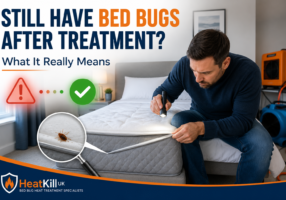
Seeing a Bed Bug Doesn't Always Mean the Treatment Failed
One of the biggest reasons customers worry after treatment is because they see what appears to be a bed bug.
There are several possible explanations:
- It may already have been dead before being noticed.
- It may be a dying insect affected by the heat.
- It may have emerged from a previously inaccessible hiding place.
- It may have been brought back into the property after treatment.
This is why professional inspections are so valuable—they help distinguish between a genuine treatment failure and normal post-treatment observations.
8. Bed Bugs Were Reintroduced After Treatment
Sometimes the heat treatment worked perfectly.
The infestation returned because the bed bugs came back from somewhere else.
This is known as reintroduction, and it's much more common than many people realise.
Bed bugs don't appear from nowhere.
They're almost always transported by people or their belongings.
Common Sources of Reintroduction
Bed bugs are excellent hitchhikers and can be picked up from:
- Hotels
- Holiday accommodation
- Airbnb properties
- Hostels
- Student accommodation
- Public transport
- Taxis
- Workplaces
- Schools
- Hospitals
- Visitors
- Second-hand furniture
- Used mattresses
- Shared laundry facilities
Even a single fertilised female bed bug can start a new infestation.
That's why preventing reintroduction is just as important as eliminating the original infestation.
The NHS guide to bedbugs offers practical advice on recognising bed bugs and reducing the risk of bringing them home after travelling.
Expert Tip
After staying in hotels or holiday accommodation:
- Inspect your luggage before bringing it indoors.
- Wash clothing on a hot cycle where appropriate.
- Dry clothes thoroughly using a tumble dryer if the care label allows.
- Vacuum luggage before storing it.
These simple precautions can significantly reduce the risk of bringing bed bugs home.
9. Choosing the Cheapest Company Instead of the Best Company
Professional bed bug heat treatment requires specialist equipment, careful planning and experienced technicians.
It isn't a service that can be delivered properly using minimal equipment or rushed procedures.
Unfortunately, some companies compete primarily on price.
While a cheaper quotation may appear attractive initially, it can become much more expensive if the infestation returns and another treatment is required.
Questions You Should Ask Before Booking
Before choosing any bed bug heat treatment company, ask:
- Will the entire property be treated if necessary?
- How many temperature sensors are used?
- Are temperatures monitored throughout the treatment?
- What commercial heating equipment is used?
- Are industrial circulation fans included?
- Will I receive preparation instructions?
- Is a follow-up inspection available?
- What happens if activity continues after treatment?
A reputable company should be happy to explain its treatment process clearly.
The British Pest Control Association (BPCA) recommends using a professional pest management company with appropriate knowledge, training and experience.
Case Study: Why One Previous Heat Treatment Didn't Work
A customer contacted HeatKill UK after another company had completed a heat treatment only a few weeks earlier.
The property had become extremely warm, yet the customer continued finding live bed bugs.
During our inspection, we identified several factors that may have contributed:
- Wardrobes remained tightly packed with clothing.
- Several large storage areas had received little airflow.
- Temperature monitoring inside insulated locations had not been carried out.
- Dense clutter had prevented heat from circulating effectively.
After a carefully monitored, whole-property heat treatment with improved airflow and preparation, the infestation was successfully eliminated.
Every property is different, but this demonstrates an important point:
Heat treatment itself wasn't the problem.
The issue was ensuring that lethal temperatures reached every place where bed bugs were hiding.
10. Heat Treatment Works Best as Part of an Integrated Approach
Professional heat treatment is one of the most effective bed bug control methods available.
However, every infestation is unique.
In some situations, the best long-term results come from combining heat with other professional techniques.
Depending on the circumstances, HeatKill UK may recommend:
- Professional steam treatment.
- Targeted residual insecticides.
- Specialist insecticidal dusts.
- Interceptor monitoring traps.
- Follow-up inspections.
- Ongoing monitoring in higher-risk environments.
This is known as Integrated Pest Management (IPM).
Rather than relying on a single treatment method, IPM combines several complementary techniques to maximise effectiveness while reducing the risk of reinfestation.
What Happens After a Professional Heat Treatment?
Many customers ask what they should expect once the treatment has finished.
Immediately after treatment:
- Rooms begin cooling naturally.
- Normal household activities can usually resume once your technician advises you.
- You may occasionally see dead insects in previously hidden locations.
- Some customers notice no further bites immediately, while others may take a short period to regain confidence after living with an infestation.
If a follow-up visit has been arranged, it provides an opportunity to inspect the property and answer any remaining questions.
The most important thing is not to panic if you notice something unusual in the first few days. If you're unsure, contact your pest control company for advice rather than assuming the treatment has failed.
Professional Advice from HeatKill UK
Every property presents different challenges.
The size of the infestation, the amount of clutter, the property's construction, and even the way furniture is arranged can all influence how a heat treatment is planned.
That's why professional surveys, careful preparation and continuous temperature monitoring are so important.
A successful treatment isn't simply about generating heat.
It's about making sure that heat reaches every location where bed bugs may be hiding.
Helpful External Resources
For more information about bed bugs and professional pest management, visit:
- NHS – Bedbugs: Symptoms, Treatment and Prevention
- British Pest Control Association (BPCA)
- UK Health Security Agency (UKHSA)
Common Myths About Bed Bug Heat Treatment
There are plenty of misconceptions surrounding bed bug heat treatment. Let's separate fact from fiction.
Myth 1: If the Room Feels Hot, Every Bed Bug Is Dead
False.
The air temperature in the middle of a room tells you very little about what's happening inside furniture, mattresses or wardrobes.
Professional heat treatment is measured by the temperatures reached inside bed bug harbourages, not simply by how hot the room feels.
Myth 2: Bed Bugs Can't Spread Beyond the Bedroom
False.
Although bedrooms are the most common location, bed bugs can spread throughout a property, including:
- Living rooms
- Sofas
- Hallways
- Cupboards
- Electrical sockets
- Behind skirting boards
- Curtains
- Luggage
- Clothing
This is why whole-property inspections are so important.
Myth 3: One Treatment Always Solves Every Infestation
Usually—but not always.
A professionally planned and monitored heat treatment can eliminate a bed bug infestation in a single visit.
However, heavily cluttered properties, severe infestations or reintroduced bed bugs may require additional inspections or complementary treatments.
Myth 4: Bed Bugs Become Resistant to Heat
False.
Unlike some insecticides, bed bugs cannot develop resistance to lethal temperatures.
If they survive, it's usually because their hiding place never reached the required temperature—not because they've become immune to heat.
Frequently Asked Questions
How successful is professional bed bug heat treatment?
When carried out correctly using commercial equipment, proper preparation and continuous monitoring, professional heat treatment is one of the most effective methods available for eliminating bed bugs.
Can bed bug eggs survive heat treatment?
They can if their hiding place never reaches lethal temperatures for long enough. This is why professional monitoring and correct airflow are essential.
Why am I still seeing bed bugs after heat treatment?
Possible reasons include:
- Surviving insects in cold spots.
- Newly hatched eggs from areas that didn't heat sufficiently.
- Bed bugs being reintroduced after treatment.
- Mistaking another insect for a bed bug.
A professional inspection can help determine the cause.
Should I throw away my mattress?
Usually not.
Most mattresses can be successfully treated using professional heat treatment, provided they are in good condition.
Can I sleep in my bed after treatment?
Yes, unless your technician advises otherwise.
Sleeping in your usual bed can actually help confirm whether the infestation has been successfully eliminated because bed bugs are attracted to people rather than empty rooms.
Is professional heat treatment safe?
When carried out by trained technicians using commercial equipment and following preparation guidance, professional heat treatment is considered a safe and highly effective method of bed bug control.
How long does a treatment take?
Treatment times vary depending on:
- Property size
- Amount of furniture
- Level of clutter
- Severity of infestation
- Construction of the building
A professional company should explain what to expect before work begins.
Can bed bugs return months later?
Yes—but if they do, it's often because they have been reintroduced, not because the original treatment failed.
Why Choose HeatKill UK?
Choosing the right pest control company is just as important as choosing the right treatment.
At HeatKill UK, we specialise in professional whole-property bed bug heat treatments using commercial equipment designed to maximise heat penetration and reduce the risk of bed bugs surviving.
Our service includes:
- Commercial indirect heating systems
- Powerful industrial air circulation
- Multi-point wireless temperature monitoring
- Whole-property treatments where appropriate
- Detailed preparation guidance
- Professional follow-up inspections where required
- Friendly, experienced technicians
- Honest advice before, during and after treatment
Every property is different, so every treatment is carefully planned to suit the individual circumstances of your infestation.
Our aim is simple:
To eliminate bed bugs thoroughly while giving you complete confidence throughout the process.
Need Professional Bed Bug Heat Treatment?
If you're struggling with bed bugs, don't waste time and money repeating treatments that don't solve the problem.
HeatKill UK provides professional bed bug heat treatments across much of England using commercial equipment, advanced temperature monitoring and proven treatment methods designed to maximise the chances of complete eradication.
Whether you're dealing with a small infestation in a flat or a larger problem in a family home, our experienced team is here to help.
Contact HeatKill UK today for friendly advice and a no-obligation quotation.